KNCV Advances Social Protection for People Affected by Tuberculosis in India
KNCV Tuberculosis Foundation, in collaboration with World Health Partners (WHP), India, has been working to strengthen social protection for people affected by tuberculosis (TB) through the implementation of a research project in urban Delhi.
TB is not only a health challenge but also a social and economic one. Financial hardship, income loss and limited access to social welfare often prevent people from completing treatment successfully. Addressing these social determinants is therefore essential to achieving the goals of the WHO End TB Strategy.
As TB disproportionally strikes economically inactive younger populations, it results in severe out-of-pocket expenditure and income loss. This threatens treatment adherence in addition to nutritional security. While people with TB are facing this financial distress, awareness of specific government welfare schemes is virtually non-existent. And barriers to self-enrollment are exacerbated by stigma, digital literacy and travel costs.
Frontline workers are able to successfully diagnose and identify people with TB but do not have sufficient knowledge and information about the existing welfare schemes and how to navigate the system to link patients with these schemes. The outcome is that people with TB continue to be left behind and fall on the TB Poverty Trap.
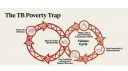
The TB Poverty Trap
About the project
From January to December 2025, KNCV Tuberculosis Foundation, in collaboration with World Health Partners (WHP), India, has been working to strengthen social protection for people affected by TB through the implementation of a research project in urban Delhi. It involved people with TB residing in low-income slum settings, disproportionally affected by high unemployment rates and severe income loss.
The project, funded by WHO-TDR, developed and evaluated practical approaches to link people with TB with government welfare and social protection schemes by strengthening frontline health worker capacity, simplifying patient navigation and improving coordination between the health and social welfare sectors.
The project has generated important implementation evidence on how National TB Programmes can better integrate social protection into routine TB services.
Findings from the study will be disseminated at the 55th Union World Conference on Lung Health, to be held in Rio de Janeiro, Brazil, through three scientific abstracts and an international symposium featuring experiences from India, Nepal, Indonesia, Viet Nam and the World Health Organization.
Through this work, KNCV continues to contribute practical evidence and global dialogue on integrating health and social protection systems, helping countries build more equitable, people-centred TB programmes that reduce the socioeconomic burden of the disease.
Ending TB requires treating the socioeconomic symptoms as aggressively as the biological ones.